


Tropical Pool Landscaping: Native and Exotic Plants for a Resort-Style Pool Garden

Tropical pool landscaping is about creating that holiday-resort feeling at home: lush green layers, big glossy leaves, splashes of rich colour, and water that feels tucked into a garden instead of sitting in the middle of a lawn.
In short: tropical pool landscaping in NSW works best when you layer suitable native plants for structure with a few exotic accents, choose a darker pool interior, group plants by their growing needs, and plan for frost and summer heat from the start.
Most of NSW isn't tropical, though. Coastal areas stay mild, but inland winters bring frost and summers bring heatwaves. The good news is that the tropical look comes less from the plants themselves and more from how the planting is put together.
What Makes a Resort-Style Pool Landscape Look Tropical?
Layering. Canopy, mid-layer and groundcover planted together, with no bare soil and no single flat hedge.
Leaf scale and gloss. Large, broad, glossy leaves create the drama. Small-leaved plants tend to look cottage or Mediterranean.
Density. The pool should feel set into the planting.
Texture contrast. Strappy leaves against broad ones, upright forms against arching ones.
Mostly green, with rich accents. Colour comes from foliage tones and a few saturated flowers.
This is also why palms can be tricky. A palm standing alone beside a pool tends to read as beach. The same palm rising out of dense, layered planting reads as tropical. Context matters more than the plant.
Designer tip: the pool colour matters as much as the plants. In our design approach, a darker pool interior, or one with a hint of green, works best for a tropical scheme. A very light, bright blue pool tends to say beach. Deeper, greener water feels more like a lagoon and makes the surrounding planting look richer. That's why we design the pool and garden together from the start. See our Custom Pool Design & Landscaping service, or compare interior options in our Ultimate Guide to Pool Finishes in Australia.
Tropical Pool Landscaping in NSW: Your Site Matters More Than the Plant Label
Coastal or inland. Frost-tender plants that thrive near the coast can struggle a short drive inland.
The pool area itself. Paving and coping reflect heat, so poolside beds are hotter and drier than the rest of the garden.
Splash. Plants at the water's edge need to cope with pool water, especially from saltwater pools.
Shade. The pool may sit in full sun while side setbacks are deeply shaded.
Soil. Heavy clay is common across much of NSW, and most tropical-style plants want rich, free-draining soil.
Route 1: Native Plants With a Tropical Look
Australia's east-coast rainforests are full of glossy-leaved, lush and colourful plants. Some are locally native to the Hunter and already used by councils as street trees, which tells you how reliably they perform here. Others are Australian natives from warmer regions, so they need more care with placement.
Feature trees
As a PARC rule of thumb, we generally allow at least 3–4 m between trees and pool structures, paving and services. The right clearance depends on the species, its mature size, site conditions and where underground services run. Some trees need more room, so we assess every planting position individually rather than relying on distance alone.
Native frangipani (Hymenosporum flavum). Locally native. A slender tree with fragrant cream-to-yellow spring flowers. It gives you the frangipani feel and copes with frost far better than the exotic frangipani, so it's a great swap for inland gardens. Protect young trees from heavy frost.
Luscious water gum (Tristaniopsis laurina 'Luscious'). A selected form of a local species. Large glossy leaves, red new growth, peeling bark and perfumed yellow summer flowers. Often described as a native alternative to magnolia, it tolerates frost and is tough on heavy clay.
Tuckeroo (Cupaniopsis anacardioides). Locally native. A dense, rounded canopy of glossy leaves with orange fruit loved by birds. It handles coastal wind and salt, and it's widely used as a street tree across the region. Allow for fruit and leaf drop.
Hard quandong (Elaeocarpus obovatus). Locally native. Glossy foliage, fringed white spring flowers and blue fruit. Allow for fruit drop.
Palms
Foxtail palm (Wodyetia bifurcata). Australian native from north Queensland, not local. It brings tropical height and a slender form that suits tighter spaces. Like any palm, it still needs appropriate clearance from pool structures and paving. It's self-cleaning, shedding the odd whole frond rather than dropping constant litter, and its fruit forms in a few clusters that can be cut off while green. It works best layered into planting, not standing alone. It handles light frost once established, but young palms need protection in frost-prone gardens.

Mid-layer and feature plants
Gymea lily (Doryanthes excelsa). NSW native. Huge strappy leaves and dramatic flower spikes. Hardy foliage; heavy frost can damage the flower buds.
Native ginger (Alpinia caerulea). NSW native. Broad, ginger-like leaves and blue fruit for semi-shade. Frost damages the leaves, but it usually reshoots.
Native cordylines (Cordyline stricta, C. petiolaris). NSW natives. Upright, strappy foliage with resort-garden character, for shade and part shade.
Swamp lily (Crinum pedunculatum). NSW native. Lush leaves and fragrant white flowers. Tough and moisture-tolerant.
Tree ferns (Cyathea, Dicksonia). For shaded corners and a rainforest feel.
Groundcover, edging and accents
Ground orchids (Spathoglottis cultivars, e.g. 'Rockin' Plum', 'Lemon Kiss'). Rich-coloured orchid flowers above pleated leaves. These are hybrid cultivars rather than local natives, and they're best in warm, sheltered spots.
Dianella. A refined strappy plant with blue berries and colourful-leaved forms.
Bird's nest fern (Asplenium australasicum). Bright green rosettes for shade.
Climbing guinea flower (Hibbertia scandens). Glossy leaves and yellow flowers. Use it on a feature trellis, never on or near the pool fence.
Route 2: Exotic Plants for the Classic Resort Look
Hibiscus (Hibiscus rosa-sinensis). Nothing says luxury resort quite like hibiscus: big glossy leaves and saturated flowers. It's frost-tender and a hungry feeder. Inland, plant it against a warm north-facing wall or grow it in a large pot.
Frangipani (Plumeria). The quintessential resort tree. It's deciduous in winter and frost-tender, and it dislikes wet feet, so on clay, plant it on a mound or in a raised bed.
Philodendron 'Xanadu' (now Thaumatophyllum). Deeply lobed leaves in a compact mound. Frost-tender.
Gardenia. Glossy leaves and fragrant white flowers for that resort scent.
Cordyline (Cordyline fruticosa). Red, pink and burgundy foliage for bright shade in frost-free gardens. Inland, swap it for the frost-hardy Cordyline australis 'Red Sensation'.
Heliconias and tropical gingers. Spectacular in warm, sheltered coastal gardens.
Bromeliads. Bold rosettes and colour (see the note below on placement).
Clivia. Tough and glossy for dry shade.
Mondo grass and liriope. Neat edging that ties planting to paving.

Mixing Native and Exotic Plants
You can combine native and exotic plants in the same garden, and sometimes in the same bed. What matters is grouping plants by their growing requirements, not by where they come from.
Natives for structure and resilience: rainforest trees, Gymea lilies and native cordylines.
Exotics for resort accents: hibiscus, frangipani, gardenia and cordylines.
Frost-tender plants in the best microclimates: near the house, under eaves or in warm corners.
Designer tip: group plants by their needs, not their origin. Plants don't need to come from the same part of the world to grow well together. They need compatible light, soil, drainage, water and feeding. Many natives prefer leaner soils and gentle, native-formulated fertilisers, while hibiscus, gardenia and many tropical exotics are hungry feeders that want rich soil and regular feeding. Where plants have different needs, give them separate zones with matching soil preparation, fertiliser and irrigation. This is what keeps a lush garden genuinely low-maintenance instead of a constant balancing act. For more on this, see How Much Maintenance Does Your Garden Require?.
At a Glance: Tropical Plants Around a Pool
Plant | Type | Climate | Poolside note |
Native frangipani | Local native tree | Coast & inland; protect young trees | Allow for canopy and flower drop |
Luscious water gum | Local native tree (selected form) | Coast & inland; frost-tolerant | Allow for mature canopy |
Tuckeroo | Local native tree | Coast & inland; protect young trees in frost hollows | Fruit and leaf drop |
Hard quandong | Local native tree | Coast & inland; protect young trees in frost hollows | Fruit drop |
Foxtail palm | Australian native palm (Qld) | Coast & sheltered inland | Still needs clearance from structures |
Gymea lily | NSW native feature plant | Coast & inland; hardy | Allow for size and flower spike |
Native ginger | NSW native | Semi-shade; frost damages leaves | Cut out old stems |
Hibiscus | Exotic shrub | Coast or warm, sheltered spots | Daily flower drop; hungry feeder |
Frangipani | Exotic tree | Coast or frost-protected spots | Winter leaf drop; raise on clay |
Philodendron 'Xanadu' | Exotic | Coast or sheltered spots | Tidy; suits beds near paving |
Cordyline fruticosa | Exotic | Frost-free, bright shade | Tidy; colour accent |
Cordyline australis 'Red Sensation' | Exotic | Inland; frost-hardy | Swap for cordyline fruticosa |
Popular "Tropical" Plants That Cause Problems Around Pools
Bamboo: why we avoid it around pools
Bamboo is often promoted as a fast way to create a tropical screen, but in our experience it creates more ongoing maintenance and containment problems around pools than almost any other plant.
Running bamboo spreads through underground rhizomes. Once it's established it can be very difficult to remove, especially when it extends under paving or into neighbouring properties. Both running and clumping varieties drop leaves that end up in pool water, skimmers and filters. Dense clumps can also give rodents a sheltered place to nest, right where you swim and entertain.
Clumping bamboo behaves differently from running types, but it isn't maintenance-free. For pool landscapes, we recommend screening plants chosen for the space available, their maintenance needs and how close they'll be to the pool.
Plants that need generous space near the pool
Golden cane palm (Dypsis lutescens). Its dense, clumping growth can take up a lot of space. Check where the mature clump will sit in relation to nearby paving and pool structures, and allow for ongoing frond litter and maintenance when you choose its position.
Bird of paradise (Strelitzia). It forms large, thick-rooted clumps over time, especially the giant form (S. nicolai). Allow plenty of room from paving and pool edges, as mature clumps are hard to move or remove.
Umbrella tree (Schefflera actinophylla). NSW WeedWise lists it as an environmental weed in NSW and notes its roots can block pipes and damage infrastructure.
Weedy or invasive plants
Cocos palm (Syagrus romanzoffiana). Listed by NSW WeedWise as a weed in the North Coast region. It spreads by seed, competes with native vegetation, and several councils are removing it. Its messy fruit also attracts rats.
Singapore daisy (Sphagneticola trilobata). A smothering groundcover recorded in coastal parts of the Hunter. NSW WeedWise advises it should not be sold in parts of NSW.
Weed status and restrictions vary by region, so check the current NSW WeedWise advice and your local council before planting.
Use with care
Bananas. Leaves shred and drop, and the plants spread.
Bromeliads. Some bromeliads hold water in their leaf rosettes, so think about where you place them and flush them regularly if mosquitoes are a concern.
Planting near the pool fence
Tropical planting tends to be dense, leafy and quick to fill out, so it needs extra thought near a pool fence. Plants, garden edges and features close to the barrier can affect whether the fence stays compliant, and plants that start well clear can grow into the wrong place over time. An attractive arrangement isn't automatically a compliant one.
Before planting near a pool barrier, check the NSW Government's guidance on pool owner obligations, which explains the requirements for barriers and non-climbable zones.
The Real Challenges of a Tropical Pool Garden in Newcastle and the Hunter
Winter frost inland. Newcastle and the coast are forgiving, but Maitland, Cessnock, Singleton and the Upper Hunter regularly get frost. Build the inland framework around frost-tolerant plants (see the table), and keep tender exotic accents in sheltered microclimates or movable pots.
Hot, harsh summers. Inland summers push into the high 30s and beyond, and heat reflected off paving makes poolside beds even hotter. Large leaves scorch and wilt. Afternoon shade, deep mulch, reliable irrigation and keeping the softest foliage away from hot surfaces all help. Well-placed trees also shade the pool and help keep the water cooler.
Drying winds. Late winter and spring westerlies dry out lush planting and shred big leaves. Shelter them behind tougher screening layers.
Clay soil. Clay soil needs to be assessed rather than treated as a single problem. Depending on its structure, drainage and sodicity, solutions may include raised beds, more organic matter, drainage works, or gypsum where the soil suits that treatment. Choosing the right approach before planting helps avoid ongoing waterlogging and poor plant performance. Raised beds also reduce soil washing onto paving and into the pool.
Coastal salt. On the coast, salt-laden winds burn soft leaves. Put tough species like tuckeroo on the exposed side.
Leaf litter, sap and pool filters. Lush planting means more organic matter, and fine litter and sap can clog filters. Plant the tidiest, lowest species closest to the water and use a coarse mulch that won't blow into the pool.
Mosquitoes and humidity. Dense, moist gardens attract mosquitoes in humid Hunter summers. See our guide to native Australian plants that keep mosquitoes away.
Supervision sightlines. Planting should enclose the pool without blocking clear views of the water from the house.
From Our Projects: Coast and Inland
Lake Macquarie: an open, exotic tropical look. For this near-coastal project, we kept the planting mainly exotic so that every plant shared similar soil, feeding and watering needs, which keeps the garden simpler to care for. Bromeliads, Philodendron 'Xanadu', ginger and gardenia are layered around an existing triangle palm, creating an open tropical feel around the pool, sun shelf and lit water feature. The palm reads as tropical, not beachy, because it's set into the planting.
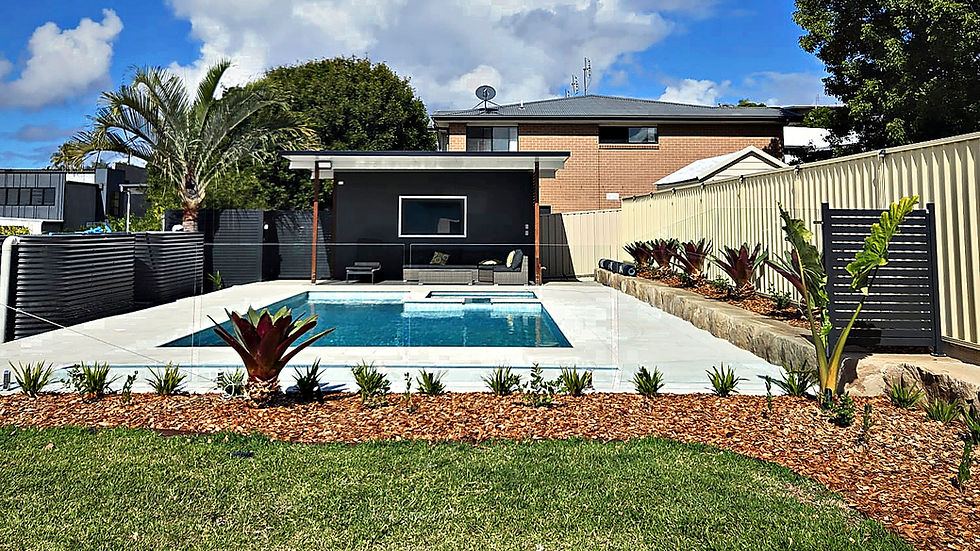
Maitland: tropical on a narrow inland site. This site is narrow, with limited space around the pool, so every plant had to earn its place. Foxtail palms give height and a tropical silhouette while suiting the tight planting space. They're self-cleaning, so instead of the constant leaf drop you'd get from bamboo, they shed the occasional whole frond, and their fruit comes in a few clusters that are easy to remove. A magnolia provides canopy shade over the resting area, set well back from the water, while the remaining planting stays low so the space feels open rather than crowded.
Frequently Asked Questions
Can you have a tropical pool garden in Newcastle or the Hunter?
Yes, you can have a tropical pool garden in Newcastle or the Hunter, as long as the planting suits where your site sits. Coastal gardens can grow a wide range of tropical-style plants. Inland areas such as Maitland, Cessnock and Singleton get regular winter frost, so the framework is best built around frost-tolerant local natives such as Luscious water gum, tuckeroo and hard quandong, with tender exotic accents kept in sheltered spots or movable pots.
What pool colour looks most tropical?
The pool colour that looks most tropical is a darker interior, or one with a hint of green. Deeper, greener water reads as a lagoon and makes the surrounding planting look richer, while a very light, bright blue pool tends to read as beach. That is why we design the pool interior and the garden together from the start.
What native plants look tropical?
The native plants that look most tropical are those with large, glossy leaves and a lush, layered form. Local natives include native frangipani, Luscious water gum, tuckeroo and hard quandong, while NSW natives such as Gymea lily, native ginger and native cordylines add strappy, resort-style foliage. Foxtail palm is an Australian native from north Queensland that also works well in sheltered spots.
Can I mix native and exotic plants around a pool?
Yes, you can mix native and exotic plants around a pool, and sometimes in the same bed. What matters is grouping plants by their light, soil, water and feeding needs rather than where they come from. Many natives prefer leaner soils, while hibiscus, gardenia and other tropical exotics are hungry feeders, so where needs differ we use separate planting zones with matching soil preparation and irrigation.
How far should trees be from a pool?
How far trees should be from a pool depends on the species, its mature size, the site and where underground services run. As a PARC rule of thumb, we generally allow at least 3–4 m between trees and pool structures, paving and services, and some trees need more room. We assess every planting position individually rather than relying on distance alone.
Designing a Tropical Pool Garden That Lasts
By designing the pool and planting together, and balancing plant selection, climate suitability, soil conditions and clearance from pool structures, a tropical pool landscape can feel lush and resort-like while staying practical to maintain through Hunter winters and summers.
Related Services:
Related Locations:
Written by Kairos Jones, Landscape Designer & Project Manager at PARC Concepts. This article reflects practical experience designing pool landscapes and planting across Newcastle, Lake Macquarie and the wider Hunter region.
Last reviewed: October 2026. This article is general information only. Plant performance varies with site conditions, and pool barrier requirements can change, so confirm what applies to your property with your local council or a registered certifier before starting work. For how we design pool landscapes in practice, see our Custom Pool Design service.


Comments