


Specialists In Swimming Pools & Landscape Designs On Slopes & Large Acreage Blocks

Landscape Design +
Project Management


Custom Garden Design
Gardens shaped around how you live—designed for function, structure, and long-term use.
What Does Professional Garden Design Actually Involve — and Is It Right for Your Property?
Garden design isn’t just about choosing plants or arranging outdoor features. It’s about shaping how a space functions, feels, and evolves over time.
At its best, custom garden design brings together how you want to live outdoors with how your property actually works — from planting and materials to movement, access, and long‑term use. Whether it’s a front garden, back garden, or a more complex outdoor environment, the goal is the same: to create a space that feels resolved, intentional, and usable.
Our garden design work forms part of our broader Landscape Design service, ensuring each garden is considered within the full context of the site, the home, and how the space will be built and used over time.
These spaces are not defined by individual features, but by how they respond to the site, connect to the home, and support how the garden is used over time.

Garden Design for Every Kind of Space
Garden design applies across a wide range of properties — from compact urban courtyards to expansive residential landscapes.
Some clients come to us with a clear direction, while others are simply trying to understand what their garden could become. In both cases, the process starts by understanding how the space is used now, and how it should function in daily life.
This might involve reworking a front garden to improve arrival and street presence, reshaping a back garden for outdoor living, or making smaller spaces feel comfortable and usable. Even simple gardens often rely on careful spatial planning to feel effortless.
While many gardens appear straightforward, factors such as slope, access, exposure, or surrounding structures can influence how the space needs to be designed. When these conditions are present, garden design becomes part of a broader landscape solution rather than an isolated exercise.

Design note from practice: the front garden has a different job
In most homes, the front garden isn’t a space for recreation or entertaining — it’s the first impression. The role of the front garden is to create a strong visual relationship between the house and the street, where people instinctively notice the overall composition rather than how the space is used.
We often design front gardens with minimal or no lawn because lawn rarely contributes to visual impact in this setting, and it increases ongoing maintenance if not carefully planned. Instead, planting and materials are used to create structure, contrast, and a more resolved, intentional appearance.
This approach also supports more sustainable outcomes. By reducing unnecessary lawn areas and selecting planting suited to the site, the garden typically requires less water, less maintenance, and performs more consistently over time. In this sense, both sustainability and low‑maintenance outcomes are not added separately — they come from how the garden is designed from the beginning.
Garden Environments We Design
Constrained and Enclosed Garden Spaces
Some gardens are defined less by their size and more by how they are enclosed and accessed.
Courtyards, balconies, and rooftop spaces are shaped by surrounding structures, limited access, and changing exposure conditions, all of which influence how they are designed and used.
These environments often involve tighter circulation, variations in light and ventilation, and a closer relationship with the building itself. As a result, design focuses on resolving these constraints in a way that supports usability, privacy, and long-term performance.
See how we approach courtyard garden design


Lifestyle & Living Spaces
Garden design often involves creating spaces that support everyday use — not just occasional use.
Garden rooms help organise how space is used, supporting relaxation, connection, and day-to-day living. These environments are shaped through proportion, layout, and how areas are defined, rather than simply adding features.
Many outdoor living spaces begin as simple ideas but require careful coordination to ensure they function across seasons and connect naturally with the home.
Wellness & Restorative Landscapes
Some garden spaces are shaped to feel quieter and more contained, supporting rest, recovery, and retreat within the landscape.
Wellness or restorative environments are defined by how the space is structured and experienced, rather than by individual features. This often involves a combination of planting density, material selection, spatial enclosure, and controlled conditions that allow the space to feel protected and consistent.
These spaces typically prioritise privacy, softness, and separation from surrounding areas, creating a more measured environment that supports slower, quieter use.
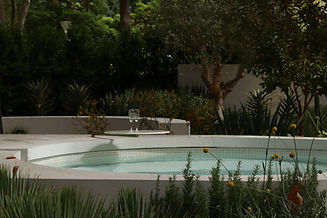
Sauna and spa areas may be integrated into these settings, not as standalone inclusions, but as part of a broader spatial sequence that supports privacy, movement, and use over time. In this context, wellness outcomes are achieved through the overall composition of the space, rather than any single element.
Outdoor Living & Use

Entertaining & Gathering Spaces
Outdoor kitchens, BBQ areas, and fire elements are often part of how people use their gardens day to day.
Rather than operating as individual features, these spaces are positioned within the overall layout to support how people gather, move, and spend time outdoors. Their success depends on how they integrate with surrounding areas, not the individual inclusions on their own.
Outdoor kitchens tend to support active use — cooking, dining, and day-to-day functionality — while fireplaces and fire pits often act as gathering points, shaping how spaces are used during cooler periods or in the evening.
Explore how outdoor cooking areas are designed as part of a broader garden layout in our outdoor kitchen design guide, and how fire elements are integrated within residential landscapes in our fireplace and fire pit design page.
Functional & Supporting Spaces
Some elements exist primarily to support how a garden works, rather than define it.
Outdoor showers and bathrooms may be included where their use improves how the space functions — particularly in settings such as pools, coastal properties, or active outdoor environments. These elements are considered in relation to access, privacy, and movement through the site, ensuring they integrate with the overall layout rather than becoming standalone features.
Outdoor showers and bathrooms often act as transitional elements — supporting how a landscape is used before, during, and after time spent outdoors, rather than becoming a central feature of the design.
Where these elements involve enclosure, services, or coordination with other built elements, they are resolved as part of the broader landscape design, ensuring they integrate with the site and function reliably over time.

Designing Low‑Maintenance Gardens That Actually Last
Low‑maintenance gardens are frequently misunderstood.
They are not:
-
maintenance‑free
-
achieved through plant shortcuts
-
or solved by a single decision
Instead, low‑maintenance outcomes are the result of how the entire landscape is designed.

What Low‑Maintenance Garden Design Really Means
A low‑maintenance garden is one where ongoing effort has been reduced through planning and design.
This is influenced by:
-
how the garden is laid out and connected
-
how large and fragmented spaces become
-
the materials used
-
and how plants behave over time, not just how they look initially
When these elements are aligned, the garden requires less intervention and becomes more stable as it matures.
In practice, low‑maintenance design often leads to more sustainable outcomes. Many of our projects reduce or remove unnecessary lawn areas and instead rely on planting and material choices that are better suited to the site. This reduces ongoing water use and maintenance while improving how the garden looks and performs over time. Sustainability in this context is not a separate feature, but a result of considered design decisions.
At PARC Concepts, low maintenance is closely tied to how we define sustainability in a residential landscape. Rather than treating sustainability as a separate feature, we approach it as an outcome of design decisions that respond to the environment, support how the space is used, and reduce long-term resource input.
“A sustainable garden is one where the site, the way it is used, and the long-term cost of maintaining it are considered together — not as separate decisions, but as part of a single design framework.”
This means working with site conditions, aligning materials and planting with how the space will be used, and reducing reliance on ongoing intervention over time.
Design Decisions That Reduce Maintenance Over Time
Low‑maintenance outcomes come from a series of connected design decisions rather than a single approach.
This includes:
-
Selecting plants based on growth habit and long‑term behaviour rather than appearance alone
-
Grouping planting to reduce pruning and simplify ongoing care
-
Positioning hard surfaces to minimise edges that require maintenance
-
Preparing soil conditions to support consistent plant performance
-
Planning irrigation so it operates reliably without constant adjustment
These decisions reduce variability over time, making the garden easier to manage as it evolves.
In practice, the maintenance problems we see most often aren’t caused by plant selection alone. They come from how the garden is laid out and how it functions day-to-day. When access is awkward, edges are excessive, or spaces are fragmented, even a simple garden becomes labour‑intensive. Low‑maintenance outcomes are usually the result of decisions that are not visible at first, but become obvious as the garden matures.
Where appropriate, elements such as lighting are considered at this stage, ensuring the space can be used comfortably in the evening while remaining integrated and low‑maintenance over time.


Why Low‑Maintenance Starts With the Site
Every site behaves differently.
Sun exposure, slope, drainage conditions, and soil type all influence how a garden performs. If these are not considered early, even simple gardens can become high‑maintenance.
When they are understood and integrated into the design, the garden becomes more predictable, balanced, and easier to manage over time.
In many cases, irrigation is also addressed at this stage. Where planting is aligned correctly with soil, climate, and exposure, long-term irrigation can often be reduced or limited to an initial establishment period. Rather than being treated as a default inclusion, irrigation systems are considered as part of early landscape planning and used where they are genuinely required based on site conditions.
For a practical overview of installation considerations and system costs, see our guide to irrigation installation cost.
Is a Low‑Maintenance Garden Right for Every Property?
In some cases, low‑maintenance outcomes are straightforward. In others, they involve trade‑offs between planting richness, spatial complexity, and long‑term upkeep.
For some properties, simplifying maintenance may limit planting density or reduce design flexibility. For others, it can be achieved with minimal compromise.
Low‑maintenance outcomes are best achieved when garden design is planned as part of a complete landscape design, rather than treated as an isolated goal.


When Garden Design Becomes More Complex
Some projects involve conditions or features that require a more resolved approach. This may include:
• compact or highly constrained sites
• elevated or rooftop environments
• large or varied landscapes
• integrated outdoor structures or functional elements (such as outdoor kitchens, pools, or supporting facilities)
• specialised recreation areas
• limited or challenging site access for construction and long-term maintenance
These elements can influence layout, construction, and how the space is used, and in some cases may also introduce [approval considerations] depending on how they are designed or built.
Where this occurs, these elements are addressed as part of a broader landscape design process, ensuring they are resolved in context rather than as isolated decisions.
Site access can influence how materials are brought in, how the space is constructed, and how easily it can be maintained over time. For further insight into how access conditions affect landscape design and construction, see our guide to how site access affects landscape design and construction.

How we approach garden design in practice
Garden design decisions are not made in isolation. Every project involves balancing how a space should feel with how it will function over time.
Rather than starting with features or finishes, we focus on how the space will be used, how it connects to the home, and how it will perform after it is built. This approach allows the garden to feel resolved from the beginning, rather than adjusted over time.
This is applied across a range of complex residential sites throughout Newcastle, the Hunter Region and broader NSW, where conditions such as slope, scale or environmental factors require a more considered response.
Let’s Design Your Landscape with Purpose
If you’re exploring how your outdoor space could be reshaped, the first step is understanding what’s possible and how your site responds to it.
Garden Design FAQ
What is the difference between garden design and landscape design?
Garden design focuses on how outdoor spaces feel and function at a human scale — including planting, layout, and everyday use. Landscape design considers the broader site, including levels, structures, and how the garden integrates with the property as a whole.
Do I need a landscape designer for a small garden or courtyard?
Even smaller gardens often benefit from professional design, particularly where space is limited or privacy, light, and layout need to be resolved carefully.
Can you design both front and back gardens as part of one project?
Yes. Garden design often considers the entire property — including both front and back gardens — to ensure consistency, functionality, and a clear relationship between spaces.
What makes a garden low‑maintenance?
A low‑maintenance garden is not maintenance‑free. It is designed to reduce ongoing effort through planting choices, layout decisions, material selection, and how the site conditions are handled over time.
Can garden design include outdoor kitchens, fire pits, or spa areas?
Garden design itself does not always require approval, but certain features, structures, or site conditions may. Where this applies, it is addressed through the appropriate design and documentation process.
Do you recommend lawn in front gardens?
Often, minimal or no-lawn front gardens perform better visually and require less upkeep long-term. Front gardens usually function as an entry statement rather than a play space, so planting and materials can be designed for impact and lower ongoing maintenance.